Advanced Oxidation Process - The future of water treatment
Granular Dosing = Small Footprint, NO External Power Required, Requires no added chemical reagents!
AOPs generate extremely strong, non-selective oxidants that attack organic compounds. Key radicals include hydroxyl radicals, sulfate radicals , carbonate radicals and superoxide radicals.
Using RedOxy treatment, RedOxy4C, OxyOne and RedOxy 3C we create AOP from a granular media without extra reagents and external power. This is accomplished with a very small footprint.
Can you make a picture that demonstrates AOP mineralization of organic pollutants.
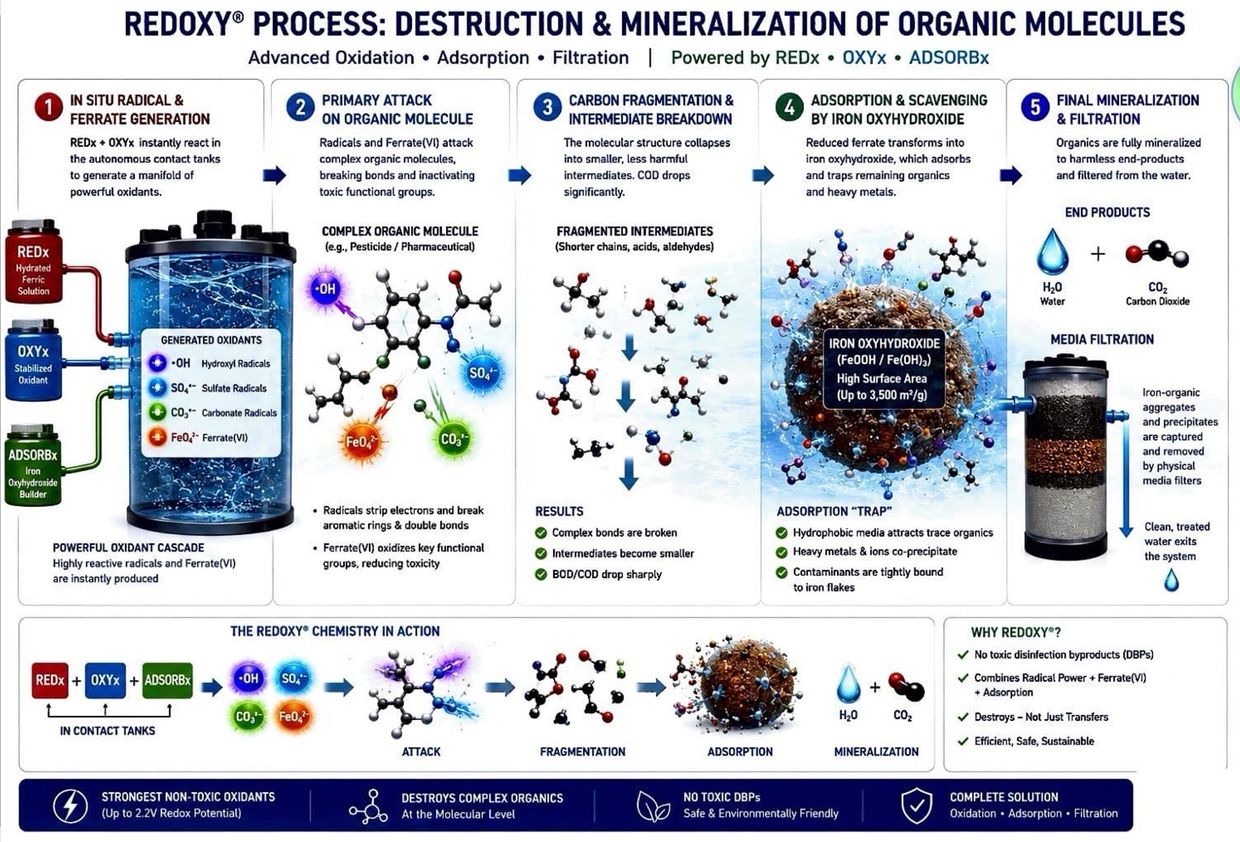
Advanced Oxidation Processes (AOPs) destroy organic molecules through a sequence of rapid chemical events. This chain reaction transforms complex pollutants into harmless end products.
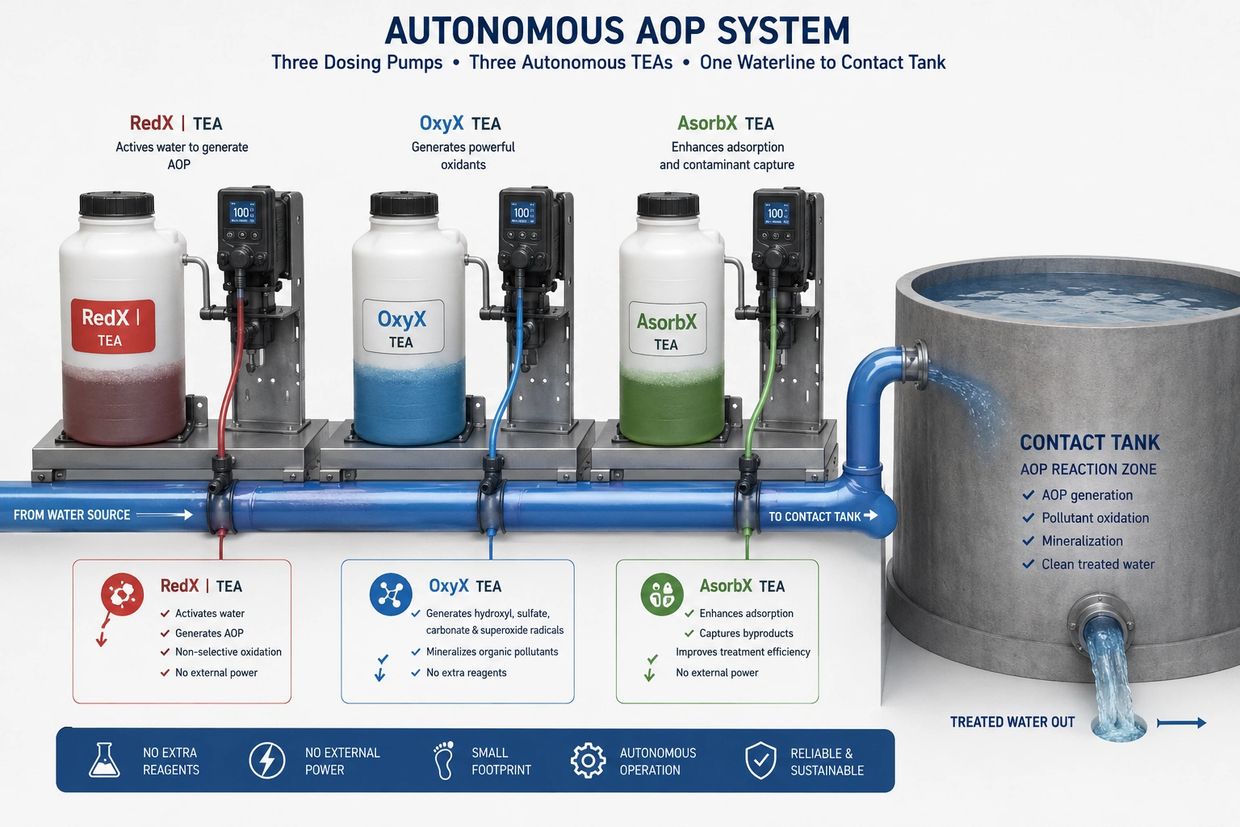
1ST step is selecting the correct dosing granular chemicals
Selection is done by identifying contaminant targets: Hydrocarbons,COD, BOD, TOC, PFAS, H2S, ect.
RedOxy® treatment by Watch Water® Germany is a proprietary, multi-functional water treatment system. It operates as an Advanced Oxidation-Adsorption-Filtration process. Unlike traditional UV or Ozone Advanced Oxidation Processes (AOPs), RedOxy uses a trio of on-site dosed or generated components—REDx, OXYx, and ADSORBx—to clean water without creating toxic disinfection byproducts (DBPs).
Instead of relying solely on radical attacks, RedOxy destroys organic molecules through a combination of radical chemistry, Ferrate(VI) power, and physical adsorption.
Step 1: In Situ Radical & Ferrate Generation
When the three primary chemical agents are mixed into the 3 autonomous contact reaction tanks and do with LMI pumps, they instantly spark a manifold of oxidative agents.
- The Component Mix: Hydrated ferric solution (REDx) reacts with a powerful stabilized oxidant (OXYx).
- The Radical Blitz: The mixture instantly creates a cascade of highly reactive radicals: Hydroxyl Radicals, Sulfate Radicals , and Carbonate Radicals.
- Ferrate(VI) Creation: Simultaneously, the process synthesizes ultra-pure Ferrate(VI), one of the strongest non-toxic oxidants known, boasting a massive redox potential.
Step 2: The Radical and Ferrate Primary Attack
The generated radicals and Ferrate immediately attack the complex organic molecules (e.g., pesticides, hydrocarbons, or pharmaceuticals).
- Radical Electron Stripping: Hydroxyl and sulfate radicals rapidly break apart unsaturated chemical bonds and aromatic rings by extracting hydrogen or transferring electrons.
- Ferrate Inactivation: Ferrate(VI) targets specific functional groups within the organic structures, instantly reducing the complex toxicity of the compound
Step 3: Carbon Fragmentation & Intermediate Breakdown
As the primary structures collapse, the organic molecule fragments.
- Chain Breakdown: The complex carbon chains fragment into simpler, shorter intermediate compounds, such as volatile organic acids or aldehydes.
- Chemical Oxygen Demand (COD) Drop: During these first few minutes, the biological and chemical oxygen demands (BOD and COD) drop steeply as the complex bonds are broken down.
Step 4: Adsorption and Scavenging via Iron Oxyhydroxide
As the Ferrate(VI) finishes its oxidation work, it naturally reduces and shifts form into a potent, physical scavenger.
- Precipitation: The reduced ferrate turns into active Iron Oxyhydroxide and Ferric Hydroxide. This structure has a massive surface area (up to 3,500 meter squared per gram).
- The Adsorption "Trap": The ADSORBx media features a hydrophobic core that attracts remaining dissolved trace organics, trapping them tightly onto the iron flakes. Any heavy metals or toxic ions are co-precipitated alongside them.
Step 5: Final Mineralization and Filtration
The process concludes by converting dissolved elements into benign solids and gases.
- Mineralization End-Products: The fully oxidized organic carbon turns into harmless carbon dioxide and water.
- Media Filtration: The resulting larger iron-organic aggregates and precipitates flow out of the contact tank and are cleanly swept away using Watch Water's physical media filters, typically Crystolite, Katalox-Light®or catalytic carbon units.

Water polishing and regulatory compliance treatment tree.
Reach any level of purification necessary to achieve your goals and overcome your challenges
Nature has spent eons achieving balance in nature.Advanced oxidation process is natural Bio mimicry